

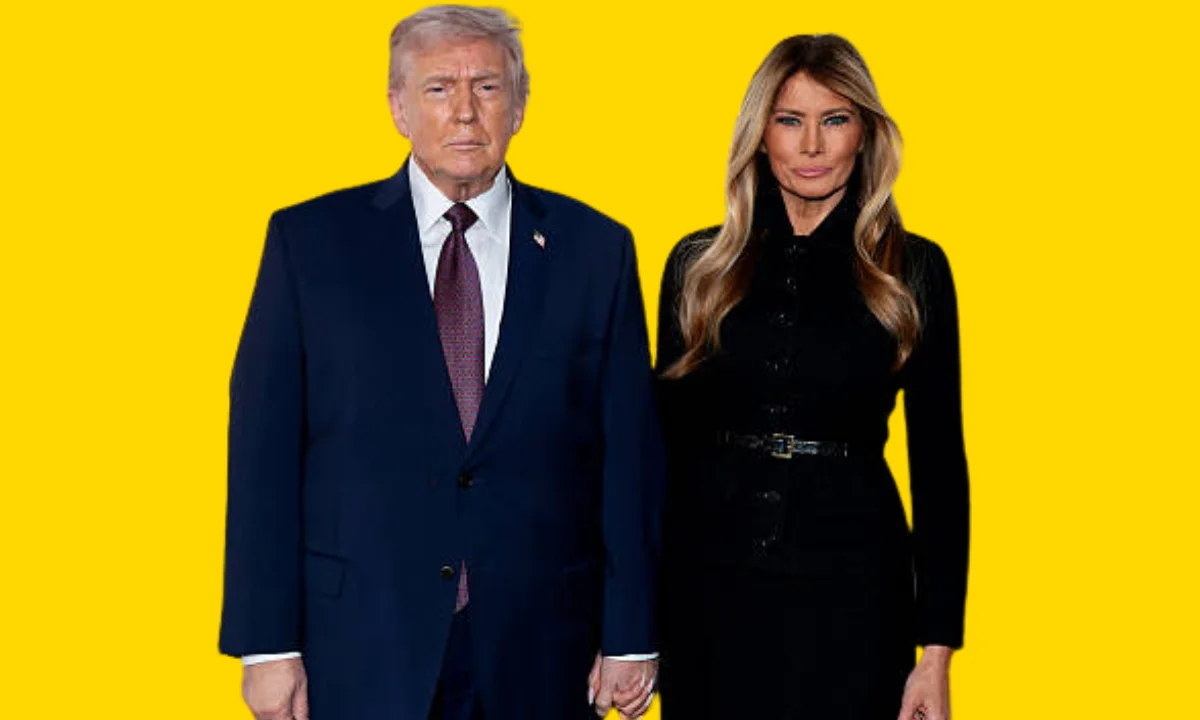
At some point, everyone in Donald Trump’s orbit gets their turn.
That, according to people close to the former president, is the unspoken rule that keeps the peace inside the Trump family. Each member eventually gets their “due”—attention, money, visibility—and in exchange, Trump tolerates the lingering resentment that everyone, in his view, is profiting off him.
This time, it’s Melania’s turn.
Her new documentary-style film—part self-portrait, part glamour reel—arrived not simply as entertainment, but as a statement. A carefully controlled, tightly curated assertion of independence from her husband, even as it relies entirely on his power, fame, and presidency to exist in the first place.
And that contradiction sits at the heart of everything the film reveals—often unintentionally.
A Movie That Barely Anyone Is Watching
The rollout itself tells a story.
Initially projected to make around $5 million on opening weekend, estimates quickly slid to $2 million, then lower. Reports circulated that in Australia, only a single ticket was sold. In many U.S. theaters, screenings were sparsely attended—nearly empty matinees with more chatter than applause.
And yet, for those who sat through it, the verdict was surprisingly consistent: the film isn’t unwatchable. In fact, it’s slick, glossy, and oddly hypnotic.
That’s because it isn’t really a documentary. It’s a Melania Trump commercial.
An 80s Music Video Disguised as a Portrait
From the opening moments, the film establishes its aesthetic. Rolling Stones. Michael Jackson. Tears for Fears. Wall-to-wall 1980s pop anthems create a mood closer to MTV than PBS.
Visually, it plays like a high-budget music video: Melania gliding in and out of black SUVs, motorcades slicing through Washington, helicopters lifting off rooftops. The tone is pure “power porn”—Washington as fantasy, authority as glamour.
Director Brett Ratner, returning from exile after years of industry silence, frames Melania not as a political figure but as a model performing the role of First Lady. Which makes sense. That is, essentially, what the film is.
She doesn’t speak directly to the audience. Instead, there’s a voiceover—vague, abstract, and curiously hollow—talking about “global initiatives” and “fostering the future,” without ever naming a specific cause, policy, or outcome.
There is show. There is no tell.
Total Control, Total Distance
One thing the film makes abundantly clear: Melania controlled this project.
She is the producer. Nothing appears without her approval. Every shot, every angle, every moment exists because she allowed it. In that sense, the movie is less revealing than declarative—it shows us how she wants to be seen.
And how she wants to be seen is separate.
There is almost no interaction with Donald Trump. When he appears, it’s fleeting and awkward. He calls her repeatedly during election night, anxious for her validation. She barely engages. She doesn’t watch the results. She doesn’t seem interested.
At the end of inauguration day, they go their separate ways—literally. The film lingers on this moment, making it unmistakably clear: they do not share a bedroom, a routine, or a life in the conventional sense.
This separation is not hidden. It is performed.
The Transactional Marriage
Behind the scenes, Trump’s feelings about the film are reportedly muted, bordering on irritated.
People close to him describe a familiar pattern: he understands the deal. Everyone in the family believes they are owed. Everyone believes he must deliver. And allowing these projects—books, movies, branding—is part of what keeps the family stable.
But it also feeds his deepest resentment.
Trump believes his family is “mooching” off him. Not just Melania—everyone. In his worldview, whatever they have comes from him. And while he accepts the transaction, he never stops resenting it.
Melania’s film, in that sense, fits perfectly into the larger family dynamic: tolerated, not celebrated.
The Immigrant Dream—Carefully Framed
One of the film’s recurring themes is the “immigrant dream.” Nearly everyone Melania works with—designers, stylists, creatives—is an immigrant. Their stories are briefly highlighted, reinforcing her narrative as a symbol of success through migration.
Yet the irony is unavoidable. Her own story—the truly extraordinary arc from Slovenia to the White House—is barely explored. Instead, the film focuses obsessively on wardrobe fittings, event aesthetics, and approval of decisions already made by professional planners.
She is positioned as a tastemaker, not a decision-maker.
Performative Intimacy and Power Optics
There are moments meant to suggest intimacy—hand-holding, whispered exchanges—but they feel staged. Adult hand-holding, especially in positions of power, comes across less as affection and more as performance.
Trump appears to cling. Melania appears to tolerate.
In one telling exchange, Trump gushes over her appearance, calling her a movie star. She redirects the conversation to their son, Barron—asking if Trump has spoken to him. The exchange suggests parallel parenting, not partnership.
Even their shared concern about security—whether Barron will exit the car in public—underscores distance rather than unity.
What the Film Doesn’t Say
Equally striking is what’s missing.
There is no mention of Jeffrey Epstein. No mention of Ghislaine Maxwell. No acknowledgment of Melania’s documented proximity to that social circle—despite fresh Epstein file releases landing the same day as the movie’s debut.
To some observers, the timing felt passive-aggressive. A subtle reminder that while Melania was releasing a polished fantasy, reality was intruding elsewhere.
The contrast was stark: a movie about control and image, released alongside a data dump about chaos, secrecy, and denial.
A Portrait of Separation, Not Power
Ultimately, the film doesn’t confirm the fantasy many supporters may hold—a glamorous First Lady in a happy, powerful marriage.
Instead, it reveals something colder and more transactional.
Melania emerges as a team player when necessary, a brand unto herself when possible, and a figure determined to assert separation from her husband—even as she profits from the system he built.
It’s a movie about independence that only exists because of dependence. A story about image without substance. A performance of power that carefully avoids truth.
And perhaps that’s the most revealing thing of all.
Conclusion
Taken together, the film, the Epstein files, and the crisis in Minneapolis form a revealing snapshot of Trump-world at a moment of deep instability. Melania’s documentary, intended as a carefully controlled act of self-definition, instead underscores her distance—from her husband, from traditional expectations of a first lady, and from any genuine political or emotional engagement. What emerges is not intimacy or insight, but a glossy exercise in image management, one that feels more like a brand extension than a personal statement.
At the same time, the release of the Epstein files exposes the fragility of long-standing denials among powerful elites and reinforces the sense that truth is being buried under sheer volume and distraction. Add to this the aggressive federal response in Minneapolis, and a pattern becomes clear: governance by escalation, retreat, and normalization of extremes. The administration appears less concerned with stability or accountability than with testing how far it can push before resistance hardens.
Ultimately, the conversation circles back to a single idea—transactional power. Whether in family dynamics, political strategy, or international relations, everything is framed as something owed, taken, or extracted. The result is a spectacle-driven moment where image eclipses substance, and where the long-term cost—to institutions, public trust, and America’s global standing—may far outlast the news cycle that struggles to keep up.
FAQs
What is Melania Trump’s documentary really about?
Despite being marketed as a revealing portrait, the film focuses narrowly on image, fashion, and ceremony. It avoids personal history, emotional depth, or controversial topics, functioning more like a stylized glamour reel than a true documentary.
Does the film reveal anything new about Melania Trump?
Very little. Viewers learn that she values control over her image, prefers distance from her husband, and sees her role as performative rather than political. There are no meaningful insights into her ambitions, beliefs, or inner life.
How does the documentary portray Melania and Donald Trump’s marriage?
The relationship appears distant and transactional. The film emphasizes their separateness—emotionally, physically, and symbolically—showing Melania as a partner who appears when required but maintains strict independence.
Why is the film described as a “1980s music video”?
The heavy use of iconic 1980s pop songs, slow-motion visuals, luxury imagery, and minimal dialogue gives it the feel of a high-budget music video rather than a narrative-driven film.
How has the movie performed commercially?
Early box office estimates declined rapidly, and reports suggest extremely low attendance in some countries. The film’s reach appears limited, with most viewers expected to encounter it later via streaming platforms.
How does the MAGA base respond to the film?
The film’s elite aesthetic and documentary format may clash with populist messaging. Anecdotal evidence suggests limited interest among core MAGA supporters, many of whom are unlikely to seek out a documentary at all.
Why is the release of the Epstein files significant in this context?
The timing of the Epstein document release—coinciding with the film’s debut—was widely interpreted as politically and personally loaded, potentially overshadowing Melania’s attempt to control her public narrative.
What do the Epstein files suggest about powerful elites?
The files indicate that many high-profile figures who downplayed their relationships with Jeffrey Epstein maintained extensive, documented contact with him, contradicting years of public denials.
How does Minneapolis factor into the broader political crisis discussed?
Federal immigration enforcement actions in Minneapolis are framed as a turning point, with critics describing them as a form of martial law that normalizes federal force overriding local authority.
What is the broader takeaway from the transcript’s discussion?
The conversation paints a picture of an administration governed by power, image, and brinkmanship—where personal vendettas, spectacle, and maximum-pressure tactics shape both domestic policy and global perceptions of the United States.
Anne Kellogg is the creative mind behind NamesPerl, where she shares her passion for names. With 4 years of experience in crafting unique and catchy names, Anne helps readers discover the perfect words to express identity, creativity, and meaning.